For manufacturing businesses, getting your kanban reorder point right can mean the difference between thriving and merely surviving. Set it too high and you tie up capital in excess inventory. Set it too low and you're facing stockouts, production delays, and disappointed customers.
The kanban reorder point is the inventory level that triggers a replenishment order — calculated so new stock arrives just before you'd otherwise run out. Unlike traditional systems that rely on forecasting and "just-in-case" overstocking, a kanban-based approach uses actual consumption to drive your reordering cycle, giving you more precise inventory control.
Originally developed by Toyota as part of their revolutionary manufacturing system, kanban leverages simple visual cards linked to a digital backend to create a sophisticated yet easy-to-use inventory management approach. This guide walks you through everything you need to calculate and implement your kanban reorder point — including the core formula, three safety stock methods, and real-world examples.
A kanban reorder point is the minimum quantity of an item that, when reached, triggers a replenishment order. Think of it as your inventory's "smart thermostat" — it doesn't wait until you're completely out of stock to take action. Instead, it triggers replenishment at precisely the right moment to maintain optimal levels without wasteful excess.
This concept differs fundamentally from traditional inventory reorder points in several key ways:
Getting your kanban reorder point right matters for two critical reasons:
The standard reorder point formula used in kanban systems is:
N = (D × LT) + SS
Where:
This formula — sometimes called the kanban trigger point calculation — ensures you place a new order with enough lead time for replenishment to arrive before you run out, while maintaining enough safety stock to handle unexpected variations.
Note: This is the simplified kanban reorder point formula that works for most manufacturing use cases. For more complex inventory situations, more sophisticated kanban formulas are available that factor in container size and the number of kanban cards needed.
The effectiveness of your kanban reorder point calculation hinges on three key factors. Get these right, and your system creates a smooth, efficient flow of inventory that minimizes costs while maximizing availability.
Lead time is the total time from a kanban card being triggered to the inventory being restocked on the shelf. This includes:
Lead time variability is often the biggest challenge in setting accurate reorder points. A supplier that delivers in 10 days one month and 20 days the next makes your calculation far less reliable than one that consistently delivers in 13–14 days.
Demand rate measures how quickly your inventory is consumed during normal operations. This includes not just customer orders but also internal consumption for manufacturing, samples, quality testing, and potential scrap or damage.
Understanding your true demand patterns — including seasonality and growth trends — is essential for accurate kanban calculations. A simple average can be misleading if your business is growing or if demand is seasonal.
Safety stock is the buffer inventory you maintain to account for variability in both demand and lead time. It's your insurance policy against the unexpected — supplier delays, sudden demand spikes, quality issues, or transportation problems.
Properly calculated safety stock balances protection against stockouts with the cost of carrying additional inventory. We cover three calculation methods below.
Let's walk through each component of the reorder point formula with practical examples.
This represents how many units of a particular item you typically use each day. To calculate it accurately:
Example: If you used 3,650 units of Product A over the past year, your average daily usage would be 10 units per day (3,650 ÷ 365 = 10).
However, simple averages can be misleading. Consider these factors for more accurate calculations:
For more sophisticated operations, consider using statistical forecasting methods or a dedicated kanban inventory tool like Arda Cards to predict future demand more accurately using real consumption data.
Lead time encompasses the entire process from recognizing the need to order through to making the item available for use. To determine your lead time:
Example: If your last five orders took 12, 14, 13, 15, and 11 days respectively, your average lead time would be 13 days.
Key factors to consider in your lead time analysis:
Safety stock serves as your buffer against unexpected demand spikes or supply chain disruptions. Here are three approaches, from simplest to most precise:
Option 1: The Quick Estimate (Best for Getting Started)
This isn't scientific, but many manufacturers size their safety stock by adding padding to their estimates of how much they'll need during the replenishment period. Make sure the quantity fits well on the shelf or in the bin. This approach lets you implement kanban in as little as a week.
Option 2: The Max-Min Method (Best for Most Operations)
The most widely used safety stock formula in kanban systems:
Safety Stock = (Max Daily Usage × Max Lead Time) − (Avg Daily Usage × Avg Lead Time)
Example: If your maximum daily usage is 15 units, maximum lead time is 18 days, average daily usage is 10 units, and average lead time is 13 days:
(15 × 18) − (10 × 13) = 270 − 130 = 140 units
This approach is straightforward and reliable. It may result in slightly higher safety stock levels than necessary, but it's easy to implement and works well for most manufacturing operations.
Option 3: The Statistical Method (Best for High-Volume Operations)
For businesses requiring more precision:
Safety Stock = Z × σLTD
Where:
The σLTD can be calculated as:
σLTD = √(LT × Variance of Daily Demand + D² × Variance of Lead Time)
Example: With average daily demand of 10 units (variance of 4), average lead time of 13 days (variance of 2):
σLTD = √(13 × 4 + 10² × 2) = √(52 + 200) = √252 ≈ 15.9
With a 95% service level (Z = 1.65):
Safety Stock = 1.65 × 15.9 ≈ 26 units
This statistical approach typically results in lower safety stock levels while maintaining your desired service level. Learn more in our complete guide to calculating safety stock in kanban.
Now combine all three components using the kanban reorder point formula:
N = (D × LT) + SS
Example: With average daily usage of 10 units, lead time of 13 days, and safety stock of 26 units:
N = (10 × 13) + 26 = 130 + 26 = 156 units
This means when your inventory drops to 156 units, it's time to place a new order to ensure you don't run out before the new shipment arrives.
Your reorder point calculation isn't a set-it-and-forget-it value. After implementing your initial kanban reorder points, monitor performance and adjust:
The key advantage of a kanban system is that it makes these adjustments visible and actionable. When cards or signals are consistently arriving too early or too late, your team can see the problem and respond.
Many manufacturers wonder how a kanban-based reorder point differs from a traditional reorder point system. Here's a quick comparison:
For a deeper dive into this distinction, see our guide on push vs. pull inventory management.
The kanban reorder point formula is N = (D × LT) + SS, where D is average daily demand, LT is lead time in days, and SS is safety stock. This calculates the inventory level at which you should trigger a replenishment order to avoid stockouts.
The kanban trigger point calculation uses the same formula as the reorder point: multiply your average daily demand by your lead time, then add your safety stock buffer. For example, with 10 units/day demand, 13-day lead time, and 26 units of safety stock, your trigger point is 156 units.
A typical kanban safety factor ranges from 10% to 50% of lead-time demand, depending on demand variability, supplier reliability, and item criticality. Most manufacturers start with 20–30% and adjust based on actual performance. For items with stable demand and reliable suppliers, 10–15% may be sufficient.
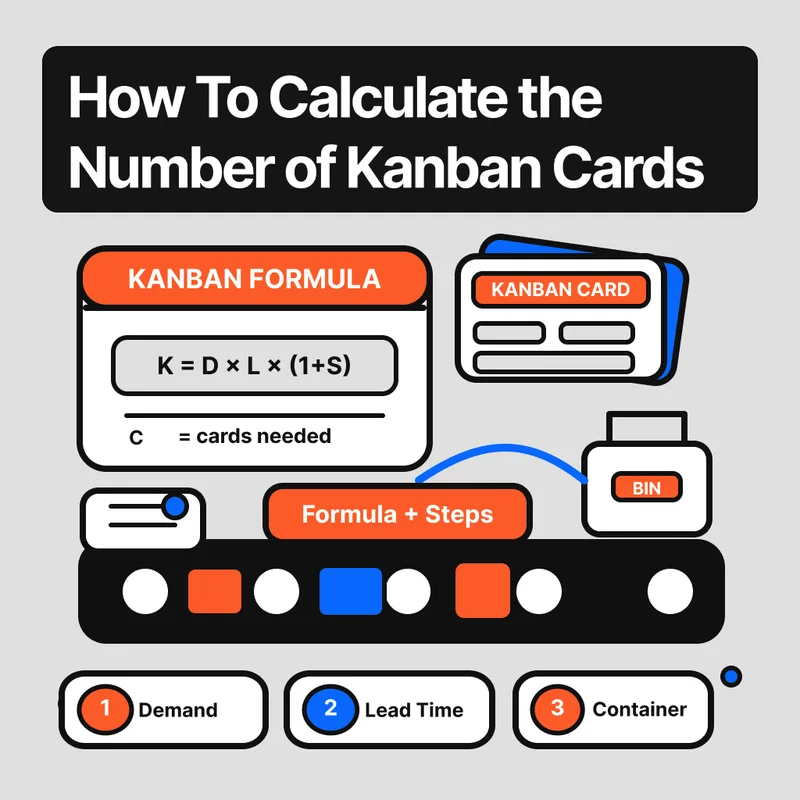
The kanban number of cards formula is: N = DT(1 + X) / C, where D is daily demand, T is lead time, X is the safety factor (as a decimal), and C is container capacity. This tells you how many kanban cards (and containers) you need in your kanban loop.
A traditional reorder point relies on software systems and forecasts to trigger orders. A kanban reorder point uses visual signals — physical cards or QR codes — driven by actual consumption on the shop floor. Kanban systems typically require less inventory to achieve the same service level because they respond to real demand rather than predictions.
Review your kanban reorder points at least quarterly, or whenever you experience significant changes in demand patterns, lead times, or supplier performance. Many manufacturers track kanban statistics monthly and adjust as needed.
While traditional inventory systems take months to implement, Arda gets your first kanban loop up and running in less than a week:
Arda's hybrid approach combines scannable kanban cards with a powerful digital backend that automatically tracks consumption data — giving you the real-time visibility you need to optimize your reorder points over time. Try the free kanban card generator to see how simple it is, or schedule a demo to see the full platform in action.
Mastering your kanban reorder points is a critical step toward transforming how your business manages inventory. By applying the formula and methods in this guide, you can build a lean, responsive inventory system that minimizes costs while ensuring material availability.
The beauty of the kanban approach lies in its adaptability. Whether you're running a machine shop or a complex manufacturing facility, the core principles of visual management, pull-based replenishment, and data-driven reorder points remain powerful tools for optimization.
Remember that implementing an effective kanban system is not a one-time event but an ongoing process of refinement. Regularly review your reorder points, adjust your safety stock levels, and optimize your bin sizes based on changing business conditions and performance data.
Ready to put these calculations to work? Arda makes it easy to set up your kanban reorder points and start tracking consumption data from day one — no complex ERP implementation required. See Arda pricing to find the plan that fits your operation.
Arda Cards

For manufacturing businesses, getting your kanban reorder point right can mean the difference between thriving and merely surviving. Set it too high and you tie up capital in excess inventory. Set it too low and you're facing stockouts, production delays, and disappointed customers.
The kanban reorder point is the inventory level that triggers a replenishment order — calculated so new stock arrives just before you'd otherwise run out. Unlike traditional systems that rely on forecasting and "just-in-case" overstocking, a kanban-based approach uses actual consumption to drive your reordering cycle, giving you more precise inventory control.
Originally developed by Toyota as part of their revolutionary manufacturing system, kanban leverages simple visual cards linked to a digital backend to create a sophisticated yet easy-to-use inventory management approach. This guide walks you through everything you need to calculate and implement your kanban reorder point — including the core formula, three safety stock methods, and real-world examples.
A kanban reorder point is the minimum quantity of an item that, when reached, triggers a replenishment order. Think of it as your inventory's "smart thermostat" — it doesn't wait until you're completely out of stock to take action. Instead, it triggers replenishment at precisely the right moment to maintain optimal levels without wasteful excess.
This concept differs fundamentally from traditional inventory reorder points in several key ways:
Getting your kanban reorder point right matters for two critical reasons:
The standard reorder point formula used in kanban systems is:
N = (D × LT) + SS
Where:
This formula — sometimes called the kanban trigger point calculation — ensures you place a new order with enough lead time for replenishment to arrive before you run out, while maintaining enough safety stock to handle unexpected variations.
Note: This is the simplified kanban reorder point formula that works for most manufacturing use cases. For more complex inventory situations, more sophisticated kanban formulas are available that factor in container size and the number of kanban cards needed.
The effectiveness of your kanban reorder point calculation hinges on three key factors. Get these right, and your system creates a smooth, efficient flow of inventory that minimizes costs while maximizing availability.
Lead time is the total time from a kanban card being triggered to the inventory being restocked on the shelf. This includes:
Lead time variability is often the biggest challenge in setting accurate reorder points. A supplier that delivers in 10 days one month and 20 days the next makes your calculation far less reliable than one that consistently delivers in 13–14 days.
Demand rate measures how quickly your inventory is consumed during normal operations. This includes not just customer orders but also internal consumption for manufacturing, samples, quality testing, and potential scrap or damage.
Understanding your true demand patterns — including seasonality and growth trends — is essential for accurate kanban calculations. A simple average can be misleading if your business is growing or if demand is seasonal.
Safety stock is the buffer inventory you maintain to account for variability in both demand and lead time. It's your insurance policy against the unexpected — supplier delays, sudden demand spikes, quality issues, or transportation problems.
Properly calculated safety stock balances protection against stockouts with the cost of carrying additional inventory. We cover three calculation methods below.