
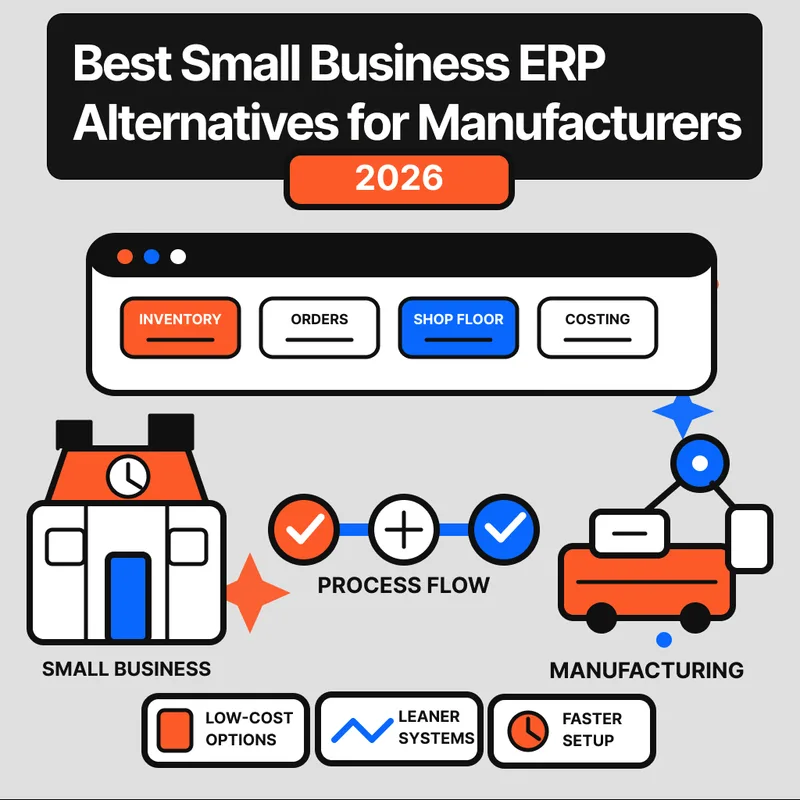
Best Small Business ERP Alternatives for Manufacturers in 2026
The best small business ERP for manufacturers in 2026 depends on size and real needs. Compare full ERPs, focused MRP tools, and kanban inventory software.
Most small manufacturers searching for ERP software are over-specifying: you need production visibility, inventory control, and reorder discipline, not a $150,000 implementation project. This guide lays out what the best small business ERP options actually are and helps you decide whether you need a full system or a focused tool.
Key Takeaways
- Full ERP makes sense at 50+ employees with multi-location operations, complex financials, or external reporting requirements. Below that threshold, it is often overkill.
- The best small business ERP options for true ERP coverage include SAP Business One, Epicor Kinetic, Acumatica, and NetSuite. All carry significant implementation costs and timelines.
- Lighter alternatives (Katana, Fishbowl, JobBoss2, E2 Shop, inFlow) hit a middle ground: more focused than full ERP, more structured than spreadsheets.
- Kanban-based inventory software like Arda solves the most common pain point for small manufacturers: getting materials reordered before a bin runs dry, without the ERP overhead.
- The right system depends on three questions: how complex are your financials, how many locations do you run, and is your core pain inventory or company-wide data integration?
What Do Small Manufacturers Actually Need?
Most small manufacturers need three things: to know what inventory they have, when to reorder it, and which jobs are using what. For a 20-person job shop or a 40-person fabrication shop, the daily operational problem is not general-ledger consolidation: it is a bin that ran dry mid-shift, a cutting tool that did not get reordered, or a job that stalled because someone pulled material without logging it. The fix is almost always better reorder discipline, not a full ERP implementation.
Full ERP systems are designed to consolidate every business function: accounting, HR, purchasing, production, CRM, and inventory, in a single database. That is valuable when those functions are deeply interdependent and you need a single source of truth across departments. For a shop with one location, a bookkeeper, and 15 production staff, that architecture adds cost and complexity without returning proportional value.
Before you start comparing ERP vendors, ask yourself three questions: whether you run multiple locations or entities, whether you have investors or lenders requiring consolidated financial reporting, and whether you run multi-entity accounting.
If you answered no to all three, you almost certainly do not need a full ERP.
What Is the Best Small Business ERP?
The best small business ERP is the one that matches the actual complexity of your business, not the one with the longest feature list. For manufacturers under 50 people with a single facility, that often means a focused MRP or inventory tool rather than a full ERP suite. For shops at 50-plus employees running multi-location or multi-entity operations, a true ERP like SAP Business One, Epicor Kinetic, or Acumatica starts to make sense.
The honest answer is that "best small business ERP" is a search term that leads many small manufacturers toward software that is bigger than their problem. A 30-person CNC shop doing $8M in revenue does not have the same software requirements as a 200-person contract manufacturer. The market uses the same phrase for both.
The framework below will help you figure out which category you belong to before you talk to any vendor.
| Category | Scope | Typical Cost Range | Avg. Implementation | Best For |
|---|---|---|---|---|
| Full ERP | Finance, HR, CRM, production, inventory | $25K–$150K+ (year one) | 6–18 months | 50+ staff, multi-location, complex financials |
| Focused MRP / shop software | Production scheduling, BOM, basic inventory | $300–$1,500/mo | 4–12 weeks | 15–80 staff, single facility, job or batch production |
| Kanban inventory layer | Inventory replenishment, stockout prevention | $100–$500/mo | Days | Any size manufacturer where inventory control is the primary problem |
Note: ERP pricing is highly variable and typically quote-based. Ranges above are illustrative.
When Does a Full ERP Make Sense?
Full ERP makes sense when your business complexity genuinely requires it. The clearest signal is multi-location operations: if you run two facilities and need synchronized inventory, production schedules, and financials, a full ERP earns its integration overhead. A second clear signal is external financial reporting requirements: if you have investors, a bank covenant, or an audit requirement, you need consolidated financials that most lightweight tools cannot produce cleanly.
The third signal is headcount and departmental complexity. Once you have a dedicated finance team, a separate purchasing function, and HR requirements that touch payroll and compliance, the case for a single system covering all three gets stronger. Below 50 people, most manufacturers are running with a bookkeeper and QuickBooks, and that setup pairs fine with a focused production or inventory tool.
The fourth signal is that you are outgrowing your current patchwork. If you are running three separate tools that do not talk to each other and your team is manually reconciling data every week, a full ERP can eliminate that friction. But be honest about the cause: sometimes the fix is better integrations between lighter tools, not a full ERP replacement.
What Are the Best Full ERP Options?
The best full ERP options for small manufacturers are SAP Business One, Epicor Kinetic, Acumatica, and NetSuite. Each has a different profile for manufacturer fit, deployment model, and total cost of ownership. None of them are cheap or fast to implement: expect 6 to 18 months and a six-figure year-one investment across software, implementation, and training.
SAP Business One is SAP's entry-level ERP, covering financials, inventory, production, and CRM in a single system. Even "entry-level" SAP carries substantial implementation complexity and consulting costs. It fits manufacturers who need strong financial reporting and are willing to invest the time and budget to match.
Epicor Kinetic (by Epicor Software Corporation, formerly Epicor ERP) is built with manufacturing at its core. It handles job costing, BOM management, shop-floor scheduling, and quality management better than most generalist ERPs. It is the strongest fit for job shops and make-to-order manufacturers in the 50-to-500 employee range, though implementation requires a dedicated internal project owner.
Acumatica (by Acumatica, Inc.) is a cloud-native ERP with strong manufacturing modules and a consumption-based pricing model (per transaction, not per seat) that can favor manufacturers with variable user counts. It covers financials, production, inventory, and distribution in a fully cloud-hosted system. Implementation still takes months and requires a qualified implementation partner.
NetSuite, made by Oracle, is the dominant cloud ERP for growing mid-market businesses, excelling at financial consolidation, multi-entity reporting, and cross-business-unit scaling. Its manufacturing modules are functional but less specialized than Epicor's. It fits manufacturers that are growing fast and need finance and operations on the same platform, though licensing and implementation costs sit at the higher end of this category.
What Are the Best ERP Alternatives?
The best ERP alternatives for small manufacturers are focused tools covering production, inventory, or shop management without the full ERP footprint. They do not consolidate financials or HR, and for most shops under 50 people, that is exactly the point. You get the functionality you actually use, faster, for less money.
Katana is a cloud-based manufacturing tool designed for small manufacturers doing make-to-stock or make-to-order production, covering BOM management, production scheduling, inventory tracking, and purchase orders. It integrates with QuickBooks and Xero, keeping your accounting outside the tool. It fits small product manufacturers and light-assembly shops well.
Fishbowl is an inventory and manufacturing tool built to extend QuickBooks, making it a common upgrade path for shops that need better inventory and production tracking than QuickBooks provides natively. It handles work orders, BOM, barcode scanning, and multi-location inventory. It fits shops that want tighter inventory control without replacing their existing accounting setup.
JobBoss2 (formerly JobBoss, now part of ECi Software Solutions) is purpose-built for job shops doing custom fabrication or CNC machining on job-by-job contracts. It covers estimating, scheduling, job costing, and shop-floor tracking. It is less focused on inventory replenishment and more focused on job execution, so if your core pain is stockouts rather than job management, it is not the right fit.
E2 Shop System (also by ECi) covers similar ground to JobBoss2, including quoting, scheduling, production tracking, and quality management for job shops. It is a solid option for small to mid-size contract manufacturers. Like JobBoss2, its strength is job management, not inventory replenishment or kanban.
inFlow is a lightweight inventory-management tool that covers purchasing, sales orders, and stock tracking. It is simpler than the other tools in this list, more appropriate for distributors or light assemblers than complex manufacturers. If your production is minimal and your core need is stock visibility, inFlow is a low-friction starting point.
When Does Kanban Beat ERP for Inventory?
Kanban beats ERP for inventory when your primary problem is replenishment, not data consolidation. Most stockout problems in small manufacturing shops are not caused by a missing ERP: they are caused by unclear reorder triggers, inconsistent bin discipline, or no signal at all for what is running low. An ERP does not fix that problem; it just adds a complex system around the same broken process.
The kanban model works on a physical or digital card system: each bin, SKU, or component has a defined reorder point, a replenishment quantity, and a signal that fires when a bin reaches its reorder point. When that system is running well, stockouts stop being a daily fire. You need clear rules, a visible signal, and a tool that enforces both, and a six-month ERP implementation is not that tool.
Arda is built specifically for this layer. A physical card with a QR code sits at each bin's reorder point: the welding consumables area, the fastener crib, the raw material rack. When stock draws down to the card, a worker scans it and gets back to work. That scan fires the reorder, the purchase order is generated, and the supplier is notified. Nobody counts anything, nobody logs into a dashboard, and there is nothing new for the floor to learn. That last part is the whole point: because there is one action to learn, the floor actually uses it, and compliance stays high.
When the card fires, purchasing knows what to order. There is no ERP configuration project, no consultant, and no six-figure year-one cost. If getting the reorder trigger right and never running dry is your core problem, Arda solves it more directly than any full ERP, a typical deployment runs in days rather than months, and you never count your inventory again.
How Do You Choose the Right System?
Choosing the right system starts with three questions. First: do you have multiple locations or entities that need synchronized financial reporting? If yes, look at full ERP; if no, you almost certainly do not need one.
Second: is your primary pain job tracking and cost management, or is it inventory visibility and replenishment? Job shops doing custom CNC work or fabrication contracts usually need job costing and scheduling, which points toward JobBoss2, E2 Shop, or Epicor. Shops whose core headache is parts running out or purchasing flying blind will find a better fit in a kanban or MRP layer, and understanding the reorder-point discipline behind kanban helps you determine whether your replenishment problem is a process gap or a software gap.
Third: what is your implementation budget and timeline tolerance? Full ERP requires dedicated internal resources for 6 to 18 months plus ongoing administration. If you do not have that capacity, a focused tool that deploys in weeks is the more realistic choice: picking a system you can actually implement beats the theoretically ideal system that never goes live.
| Question | Points to Full ERP | Points to Focused Tool |
|---|---|---|
| Multiple locations or entities? | Yes | No |
| Complex external financial reporting? | Yes | No |
| Primary pain is job costing or scheduling? | Moderate | Depends |
| Primary pain is inventory or replenishment? | No | Yes (kanban layer) |
| 50+ employees? | Yes | No |
| Implementation budget 6 figures? | Required | Not needed |
Frequently Asked Questions
What is the best ERP for a small manufacturing company? It depends on your headcount and complexity. Shops over 50 people with multi-location or multi-entity needs should evaluate SAP Business One, Epicor Kinetic, or Acumatica. Shops under 50 people with a single facility are usually better served by a focused tool: Katana or Fishbowl for production-heavy shops, Arda for inventory and replenishment.
How much does small business ERP software cost? Full ERP typically costs $25,000 to $150,000 or more in year one, covering licensing, implementation, and training (treat any specific figure as directional, as pricing is quote-based). Focused MRP or shop software runs $300 to $1,500 per month. Kanban inventory tools like Arda run $100 to $500 per month.
How long does ERP implementation take for a small manufacturer? Full ERP implementations for small manufacturers typically take 6 to 18 months, while focused tools like Katana or Fishbowl take 4 to 12 weeks. Kanban-based tools like Arda deploy in days. Implementation time is one of the most commonly underestimated costs in any ERP project.
Is SAP Business One good for small manufacturers? SAP Business One is the right fit for small manufacturers that need strong financial reporting, have 50 or more employees, and are willing to invest in a qualified implementation partner. For shops under 30 people without complex financials, the overhead is rarely justified.
What is the difference between ERP and MRP? ERP covers the full business (finance, HR, CRM, production, inventory) in one system, while MRP is the production-and-materials planning piece, which is actually a component of ERP. For the full breakdown, see our guide to ERP vs MRP.
Can I use QuickBooks instead of an ERP? QuickBooks handles accounting well but has limited production and inventory management features. Many small manufacturers run QuickBooks for accounting alongside a focused inventory or production tool: Fishbowl, Katana, or Arda, depending on their primary need. This two-tool approach is often more practical than a full ERP for shops under 50 people.
What are the biggest ERP implementation risks for small manufacturers? The three biggest risks are scope creep (expanding requirements mid-project), internal resource undercommitment (not having a dedicated owner), and underestimating data migration. Small manufacturers frequently underestimate the time required to clean and migrate historical data into a new system. These three factors account for most ERP implementation overruns and failures.
Does Arda replace ERP? No. Arda handles inventory replenishment and the kanban layer; it does not cover job costing, production scheduling, or financials, and it pairs with your existing accounting software (QuickBooks, Xero) rather than replacing it. If your primary problem is parts running out and purchasing flying blind, Arda solves that directly. For full company-wide data integration, you need an ERP or MRP system alongside it.
What is the best ERP alternative for a job shop? Job shops doing custom or contract work need job costing and scheduling more than kanban replenishment, so JobBoss2 and E2 Shop are the most natural fits. Epicor Kinetic is the stronger option once you pass 50 employees and need more scalability. If your job shop also has a storeroom or consumables crib that runs out regularly, pairing a job shop tool with Arda for the inventory layer covers both problems.
Try Arda on the parts that run out most.
Print cards, put them at the stock point, scan when you pull. It augments your ERP, it doesn't replace it.
Rossmonster reports 50% less time spent ordering and 95% of stockouts eliminated.
Related reading
8 Best Manufacturing Inventory Management Software Tools in 2026
Compare the best manufacturing inventory software for 2026. From Kanban-based shop floor tools to full MRP systems, find the right fit for your operation.
Feb 25, 2026Read article
5 Best Kanban Inventory Software for Manufacturers in 2026
Find the perfect Kanban inventory software for your shop floor. From simple hybrid tools to full e-Kanban systems, here are the top 5 picks for 2026.
Nov 13, 2025Read article
6 Best Manufacturing Inventory Software for Automated Reordering in 2026
Evaluating the top inventory software for SMB manufacturers in 2026. Compare tools for automating reordering workflows, managing consumables, and improving shop-floor usability. See our top pick for eliminating stockouts for good.
Jan 28, 2026Read article