Are you drowning in excess inventory while simultaneously missing customer delivery dates? You're not alone. Inventory management represents one of business's most persistent challenges — balancing just enough stock to meet demand without tying up capital on warehouse shelves.
This is precisely where the kanban pull system enters as a game-changer. Since Toyota engineers first developed the kanban system in the mid-20th century, this visual signaling method has transformed from an automotive industry innovation into a universal approach for optimizing inventory across virtually every sector. The results speak for themselves: organizations implementing kanban systems typically reduce inventory costs by 20–30% while simultaneously improving service levels through more responsive material flow management.
This comprehensive guide explores the fundamental principles of kanban pull systems, how they drive efficient material flow through consumption-based signals, and the various types of kanban mechanisms you can tailor to your specific inventory management needs. Whether you're new to pull systems or looking to optimize your existing approach, you'll find actionable insights to transform your inventory management strategy.
A kanban pull system is a demand-driven inventory replenishment method where materials are produced or moved only when a downstream process signals actual consumption. Instead of pushing inventory based on forecasts, the pull kanban approach lets real-time demand control what gets replenished, when, and in what quantity.
The word "kanban" translates to "visual signal" or "signboard" in Japanese, but this system represents far more than just a scheduling tool. Developed by Toyota engineers like Taiichi Ohno as a cornerstone of the Toyota Production System (TPS), the kanban pull method has evolved into a comprehensive methodology for inventory control and workflow management.
At its core, a kanban system facilitates Just-in-Time (JIT) replenishment, ensuring materials arrive precisely when needed by downstream processes or customers. This approach directly addresses what lean manufacturing calls the "eight forms of waste" (Muda) — particularly overproduction and excess inventory, which together constitute the most significant operational drains in manufacturing environments.
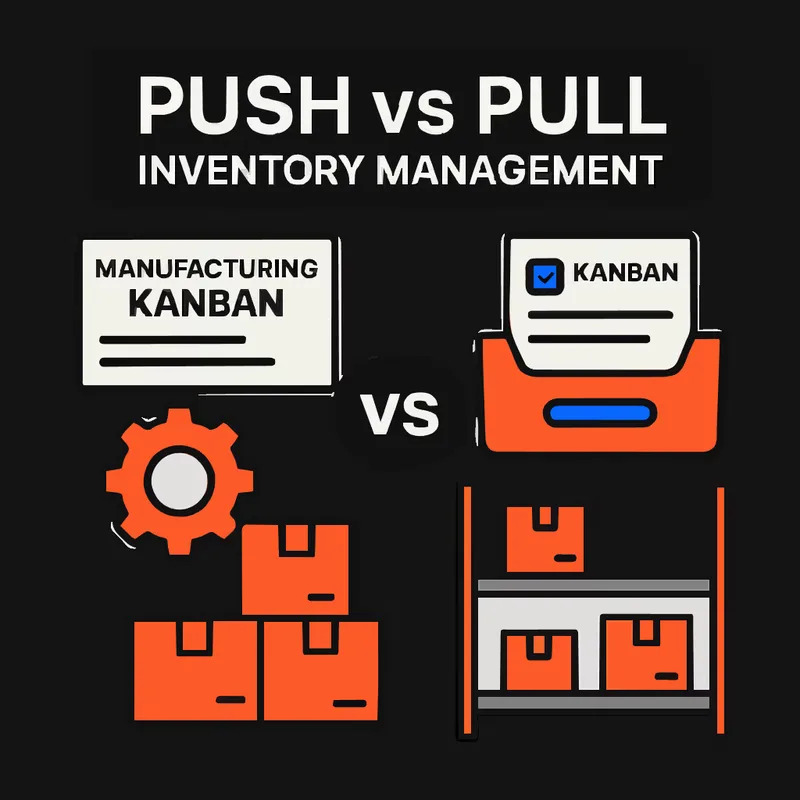
Think of it this way: rather than pushing products into the market based on what you think might sell, you're letting actual customer purchases pull new inventory through your system, much like replacing a drink from your refrigerator only after you've consumed one. For a deeper dive into how push and pull approaches compare, see our guide to push vs pull inventory management.
The power of kanban inventory management rests on four interconnected principles that work together to create a self-regulating system.
Traditional inventory management often relies on "push" systems like Material Requirements Planning (MRP) that move materials based on forecasts. Kanban systems operate on an entirely different premise: downstream processes signal their needs to upstream processes only when materials are actually consumed.
This demand-driven approach creates a chain reaction throughout the supply chain, where each process produces only what is needed by its immediate customer. The results are impressive: research consistently shows that pull-based systems reduce work-in-progress inventory compared to traditional push systems, while simultaneously improving throughput time. Companies implementing a pull-based network have seen as much as a 30% inventory reduction, a 20% increase in perfect orders, and a 10% increase in revenue.
The very name "kanban" emphasizes the critical role of visual management. Clear, easily understood visual signals — whether physical cards, colored bins, electronic alerts, or designated floor spaces — communicate inventory status and trigger replenishment actions.
Modern kanban implementations often utilize kanban boards (physical or digital) that map workflow stages (e.g., "To Order," "Ordered," "In Stock") and provide transparency by showing the status and movement of inventory items. This visibility isn't just convenient — it's transformative. Organizations using visual management techniques typically report improved cross-functional communication and faster identification and resolution of inventory issues.
A cornerstone of kanban inventory management is the explicit limitation of inventory items allowed at each stage of the workflow. By establishing WIP limits, the system prevents bottlenecks, reduces multitasking, shortens lead times, and promotes smoother material flow.
When a process reaches its WIP limit, it serves as a clear signal that an inefficiency or constraint exists and needs addressing. Organizations that implement strict WIP limits often experience reduced lead time variability and improved on-time delivery performance.
Consider this practical example: if your assembly station has a WIP limit of three bins of components, once that limit is reached, upstream processes must stop producing until space becomes available — preventing the all-too-common "tsunami" of inventory that floods operations.
Kanban systems are designed to be dynamic, exposing problems and facilitating ongoing improvement. By making workflows and inventory levels visible, and by using WIP limits to highlight bottlenecks, kanban encourages teams to continuously analyze performance and optimize processes.
Establishing regular review cycles of system performance and metrics is crucial for this evolutionary process. Companies that conduct frequent kanban reviews typically identify more improvement opportunities than those reviewing less frequently.
These four principles work in concert: the pull system cannot function without visual signals indicating when pulling is necessary; WIP limits enforce pull discipline by preventing upstream stages from producing before receiving a signal; and the visibility afforded by the system highlights opportunities for continuous improvement.
The practical application of a kanban pull system follows a specific sequence regulated by actual consumption. This process creates a self-regulating inventory system that maintains optimal stock levels without constant manual intervention.
When a downstream process (such as an assembly station) consumes materials, it triggers a kanban pull replenishment signal. This signal — whether a physical card, an empty container, or an electronic message — travels upstream to the process or location responsible for supplying that material.
Crucially, the upstream supplying process is authorized to produce or move only the specific quantity indicated by the kanban signal. This strict adherence ensures that material movement synchronizes directly with real-time consumption, preventing unnecessary inventory buildup. Properly implemented pull systems typically reduce inventory carrying costs while maintaining or improving service levels.
The regulated flow of materials occurs within what practitioners call a kanban loop — the complete circuit that kanban signals travel between the consuming point (downstream "customer") and the supplying point (upstream "supplier").
Picture it as a closed circuit: kanban cards or signals travel from the point of use back to the point of supply, authorizing production or movement of exactly what was consumed. The total number of kanbans circulating within this loop effectively sets the upper limit on inventory for that specific part within that segment of the value stream.
Organizations with optimized kanban loops generally create more predictable operations and improved cash flow management compared to traditional reorder point systems.
The effectiveness of any kanban system hinges on strict discipline. One cardinal rule is that no material should be produced or moved without an authorizing signal. Acting outside these signals — such as producing extra parts during perceived idle time or pushing inventory based on forecasts — undermines the pull mechanism and reintroduces the waste that kanban aims to eliminate.
Organizations with high signal adherence typically experience fewer stockouts and less excess inventory compared to those with lower adherence rates. This discipline isn't always easy to maintain, especially during transition periods, but it's essential for realizing the full benefits of kanban inventory management.
A key characteristic of the kanban pull system is the opposing directions of material and information flow:
This upstream flow of information is what regulates and controls the downstream flow of materials, creating a self-adjusting system that naturally adapts to changing consumption patterns. Unlike traditional inventory management approaches that push materials based on forecasts, kanban systems respond to actual usage, creating a more agile and responsive supply chain.
Kanban systems employ various types of signals to communicate material replenishment needs. Your choice of signal impacts implementation complexity, cost, visibility, and the required level of operational discipline.
Kanban Cards
Perhaps the most iconic form of kanban signals, kanban cards are physical (often laminated cardstock) or digital cards that represent a specific part number, standard quantity, source, and destination. Essential information typically includes:
Despite technological advances, many manufacturers still use physical kanban cards for at least some portion of their inventory, citing simplicity and visual impact as key advantages. The tangible nature of cards creates an unmistakable signal that's difficult to ignore or bypass.
Kanban Bins and Containers
In many systems — particularly the simple and effective two-bin system — the physical container itself acts as the replenishment signal when emptied. In a typical two-bin setup:
Multi-bin systems operate similarly but allow for more than two containers in the loop. Two-bin systems often reduce administrative overhead compared to card-based systems while maintaining comparable inventory control effectiveness.
Modern implementations often replace physical signals with electronic ones. Methods include:
These systems offer significant advantages in terms of real-time visibility, reduced human error, automated data capture for analysis, and easier integration with Enterprise Resource Planning (ERP) or Warehouse Management Systems (WMS). In one real-world case, implementing eKanban led to a 25% reduction in inventory and lead time. Transitioning to eKanban can also lead to significant improvements in efficiency, with one case study showing reductions in process time (92%), resource time (92%), and costs (93%), along with a 57% improvement in service levels.
One of the most practical approaches — especially for manufacturers transitioning from manual processes — combines the simplicity of physical kanban cards with the power of a digital backend. This hybrid kanban pull method gives shop floor workers an unmistakable visual signal they can act on immediately while capturing real-time data for managers and procurement teams.
With a hybrid system, each physical card includes a scannable QR code or barcode. When a worker scans the card to signal consumption, the digital system automatically updates inventory levels, triggers reorder workflows, and captures consumption data for analysis. This approach delivers the best of both worlds: the ease and compliance of physical signals with the visibility and optimization capabilities of software. If you're exploring this approach, you can create your own kanban cards and see how a hybrid system works in practice.
Transitioning from a push-based to a pull-based approach doesn't require an overnight overhaul. In fact, the most successful kanban implementations start small and scale incrementally. Here's a step-by-step approach:
Choose one production line, workstation, or inventory category where stockouts or excess inventory are causing the most pain. Starting with a focused pilot reduces risk and lets you demonstrate results quickly.
Document how materials currently move through your selected area. Track where inventory accumulates, where stockouts occur, and how long replenishment actually takes. This establishes your baseline and reveals the biggest opportunities for improvement.
Determine the number of kanban cards or containers you need for each part. This calculation typically considers daily demand, replenishment lead time, and a safety factor. Getting your kanban reorder point right is critical — too few kanbans and you risk stockouts; too many and you're back to excess inventory.
Choose the kanban signal type that fits your environment. For many manufacturers, physical cards or bins are the simplest starting point. Set up clear rules for how signals move, who responds to them, and what quantities get replenished.
Every person who touches the system — from shop floor workers to procurement staff — needs to understand the pull discipline: no signal, no production, no movement. Run through the workflow with your team before going live, and designate someone to monitor adherence during the first few weeks.
After 30–60 days, review your pilot results. Are stockouts down? Has excess inventory decreased? Adjust your kanban quantities based on what the data tells you, then expand the system to additional parts or production lines. Each expansion builds on what you've already learned.
A common question manufacturers face is whether a kanban pull system works for slow-moving or low-turnover parts — items consumed infrequently but still essential for production. The answer is yes, but the approach requires some adaptation.
For slow-moving items, a one-card kanban system often works better than a two-bin setup. Because consumption is infrequent, maintaining two full containers of inventory would tie up unnecessary capital. Instead, a single kanban signal triggers replenishment when stock drops below a calculated minimum.
Key considerations for low-turnover inventory in a kanban system:
The beauty of the kanban pull method for slow-moving inventory is that it prevents the two extremes most manufacturers struggle with: ordering too much (because "we might need it someday") or ordering too late (because no one was tracking it).
One of the most compelling reasons to adopt a kanban pull system is the measurable impact on inventory costs. But how exactly does pulling rather than pushing achieve this?
Elimination of overproduction. In push systems, production runs based on forecasts — and forecasts are always wrong to some degree. Kanban eliminates this guesswork by producing only what's been consumed, cutting the excess inventory that accumulates from forecast errors.
Reduced carrying costs. Less inventory on hand means lower warehousing costs, less insurance, less obsolescence risk, and more working capital freed up for growth. Companies implementing a pull-based network have reported inventory reductions of 20–30% within the first year.
Faster inventory turns. Because kanban systems maintain only what's needed to cover the replenishment cycle, inventory moves through the system faster. Higher turns mean your capital is working harder instead of sitting on a shelf.
Fewer stockouts, lower emergency costs. Paradoxically, having less total inventory through kanban often means fewer stockouts — because the inventory you do have is the right inventory. You spend less on rush shipping, emergency orders, and production line restarts.
If inventory costs are eating into your margins, exploring your pricing and implementation options is a practical next step toward regaining control.
The kanban pull system represents a fundamental shift in inventory management philosophy — replacing forecast-driven guesswork with consumption-based certainty. By implementing the four core principles of pull systems, visual management, WIP limits, and continuous improvement, organizations consistently achieve what once seemed impossible: reduced inventory costs alongside improved service levels.
Your kanban journey begins with a single step: identify one high-impact area where inventory challenges persist, map the current flow, and implement a pilot system. Remember that Toyota's approach evolved through decades of refinement — view your implementation as an ongoing practice rather than a one-time project.
The ultimate reward of kanban inventory management is liberation from the perpetual mismatch between supply and demand. By embracing this system, you join forward-thinking organizations that have discovered the counterintuitive truth at the heart of effective inventory management: the path to having more begins with holding less.
Ready to see how a kanban pull system could work in your facility? Watch a demo to see how manufacturers are eliminating stockouts and reducing inventory waste with a simple, scalable approach.
Yes. Kanban is fundamentally a pull-based method. Production and material movement are triggered only by actual downstream consumption — not by forecasts, schedules, or upstream push. The kanban signal (card, bin, or electronic alert) acts as the authorization to replenish, ensuring nothing moves without real demand.
Kanban reduces stockouts by making inventory status visible in real time and triggering replenishment the moment consumption occurs — not when someone remembers to check. The built-in discipline of signal adherence means parts are reordered consistently, before they run out. For a deeper look at how kanban inventory control systems help with reduction of stockouts, see our complete guide to stockout prevention.
Absolutely. A well-implemented kanban system provides clear visibility into what's on hand, what's been ordered, and when replenishment is expected. Digital and hybrid kanban systems take this further by capturing consumption data that helps you track delivery timelines and optimize your reorder points over time.
Pull systems can be implemented with tools as simple as physical cards and bins, or as sophisticated as integrated eKanban software. The most effective tools for manufacturers combine physical signals on the shop floor with a digital backend that captures data, automates reorder workflows, and provides dashboards for monitoring. The right choice depends on your operation's size, complexity, and existing systems — you can explore kanban inventory software options to compare approaches.
Kanban provides the signaling mechanism that makes pull systems practical. Without kanban signals, a pull system would have no standardized way to communicate what's been consumed and what needs replenishment. The kanban card or signal is what transforms the abstract concept of "demand-driven replenishment" into a concrete, repeatable workflow that shop floor workers can follow every day.
Kanban works well for most inventory categories, including high-turnover consumables, variable consumption goods, and even slow-moving parts (with adjusted parameters). It's particularly effective for inventory reduction strategies targeting items with relatively stable demand patterns. For highly unpredictable or one-time-use materials, kanban may need to be supplemented with other approaches.
Arda Cards

Are you drowning in excess inventory while simultaneously missing customer delivery dates? You're not alone. Inventory management represents one of business's most persistent challenges — balancing just enough stock to meet demand without tying up capital on warehouse shelves.
This is precisely where the kanban pull system enters as a game-changer. Since Toyota engineers first developed the kanban system in the mid-20th century, this visual signaling method has transformed from an automotive industry innovation into a universal approach for optimizing inventory across virtually every sector. The results speak for themselves: organizations implementing kanban systems typically reduce inventory costs by 20–30% while simultaneously improving service levels through more responsive material flow management.
This comprehensive guide explores the fundamental principles of kanban pull systems, how they drive efficient material flow through consumption-based signals, and the various types of kanban mechanisms you can tailor to your specific inventory management needs. Whether you're new to pull systems or looking to optimize your existing approach, you'll find actionable insights to transform your inventory management strategy.
A kanban pull system is a demand-driven inventory replenishment method where materials are produced or moved only when a downstream process signals actual consumption. Instead of pushing inventory based on forecasts, the pull kanban approach lets real-time demand control what gets replenished, when, and in what quantity.
The word "kanban" translates to "visual signal" or "signboard" in Japanese, but this system represents far more than just a scheduling tool. Developed by Toyota engineers like Taiichi Ohno as a cornerstone of the Toyota Production System (TPS), the kanban pull method has evolved into a comprehensive methodology for inventory control and workflow management.
At its core, a kanban system facilitates Just-in-Time (JIT) replenishment, ensuring materials arrive precisely when needed by downstream processes or customers. This approach directly addresses what lean manufacturing calls the "eight forms of waste" (Muda) — particularly overproduction and excess inventory, which together constitute the most significant operational drains in manufacturing environments.
Think of it this way: rather than pushing products into the market based on what you think might sell, you're letting actual customer purchases pull new inventory through your system, much like replacing a drink from your refrigerator only after you've consumed one. For a deeper dive into how push and pull approaches compare, see our guide to push vs pull inventory management.
The power of kanban inventory management rests on four interconnected principles that work together to create a self-regulating system.
Traditional inventory management often relies on "push" systems like Material Requirements Planning (MRP) that move materials based on forecasts. Kanban systems operate on an entirely different premise: downstream processes signal their needs to upstream processes only when materials are actually consumed.
This demand-driven approach creates a chain reaction throughout the supply chain, where each process produces only what is needed by its immediate customer. The results are impressive: research consistently shows that pull-based systems reduce work-in-progress inventory compared to traditional push systems, while simultaneously improving throughput time. Companies implementing a pull-based network have seen as much as a 30% inventory reduction, a 20% increase in perfect orders, and a 10% increase in revenue.
The very name "kanban" emphasizes the critical role of visual management. Clear, easily understood visual signals — whether physical cards, colored bins, electronic alerts, or designated floor spaces — communicate inventory status and trigger replenishment actions.
Modern kanban implementations often utilize kanban boards (physical or digital) that map workflow stages (e.g., "To Order," "Ordered," "In Stock") and provide transparency by showing the status and movement of inventory items. This visibility isn't just convenient — it's transformative. Organizations using visual management techniques typically report improved cross-functional communication and faster identification and resolution of inventory issues.
A cornerstone of kanban inventory management is the explicit limitation of inventory items allowed at each stage of the workflow. By establishing WIP limits, the system prevents bottlenecks, reduces multitasking, shortens lead times, and promotes smoother material flow.
When a process reaches its WIP limit, it serves as a clear signal that an inefficiency or constraint exists and needs addressing. Organizations that implement strict WIP limits often experience reduced lead time variability and improved on-time delivery performance.
Consider this practical example: if your assembly station has a WIP limit of three bins of components, once that limit is reached, upstream processes must stop producing until space becomes available — preventing the all-too-common "tsunami" of inventory that floods operations.
Kanban systems are designed to be dynamic, exposing problems and facilitating ongoing improvement. By making workflows and inventory levels visible, and by using WIP limits to highlight bottlenecks, kanban encourages teams to continuously analyze performance and optimize processes.
Establishing regular review cycles of system performance and metrics is crucial for this evolutionary process. Companies that conduct frequent kanban reviews typically identify more improvement opportunities than those reviewing less frequently.
These four principles work in concert: the pull system cannot function without visual signals indicating when pulling is necessary; WIP limits enforce pull discipline by preventing upstream stages from producing before receiving a signal; and the visibility afforded by the system highlights opportunities for continuous improvement.
The practical application of a kanban pull system follows a specific sequence regulated by actual consumption. This process creates a self-regulating inventory system that maintains optimal stock levels without constant manual intervention.
When a downstream process (such as an assembly station) consumes materials, it triggers a kanban pull replenishment signal. This signal — whether a physical card, an empty container, or an electronic message — travels upstream to the process or location responsible for supplying that material.
Crucially, the upstream supplying process is authorized to produce or move only the specific quantity indicated by the kanban signal. This strict adherence ensures that material movement synchronizes directly with real-time consumption, preventing unnecessary inventory buildup. Properly implemented pull systems typically reduce inventory carrying costs while maintaining or improving service levels.
The regulated flow of materials occurs within what practitioners call a kanban loop — the complete circuit that kanban signals travel between the consuming point (downstream "customer") and the supplying point (upstream "supplier").
Picture it as a closed circuit: kanban cards or signals travel from the point of use back to the point of supply, authorizing production or movement of exactly what was consumed. The total number of kanbans circulating within this loop effectively sets the upper limit on inventory for that specific part within that segment of the value stream.
Organizations with optimized kanban loops generally create more predictable operations and improved cash flow management compared to traditional reorder point systems.
The effectiveness of any kanban system hinges on strict discipline. One cardinal rule is that no material should be produced or moved without an authorizing signal. Acting outside these signals — such as producing extra parts during perceived idle time or pushing inventory based on forecasts — undermines the pull mechanism and reintroduces the waste that kanban aims to eliminate.
Organizations with high signal adherence typically experience fewer stockouts and less excess inventory compared to those with lower adherence rates. This discipline isn't always easy to maintain, especially during transition periods, but it's essential for realizing the full benefits of kanban inventory management.
A key characteristic of the kanban pull system is the opposing directions of material and information flow:
This upstream flow of information is what regulates and controls the downstream flow of materials, creating a self-adjusting system that naturally adapts to changing consumption patterns. Unlike traditional inventory management approaches that push materials based on forecasts, kanban systems respond to actual usage, creating a more agile and responsive supply chain.