
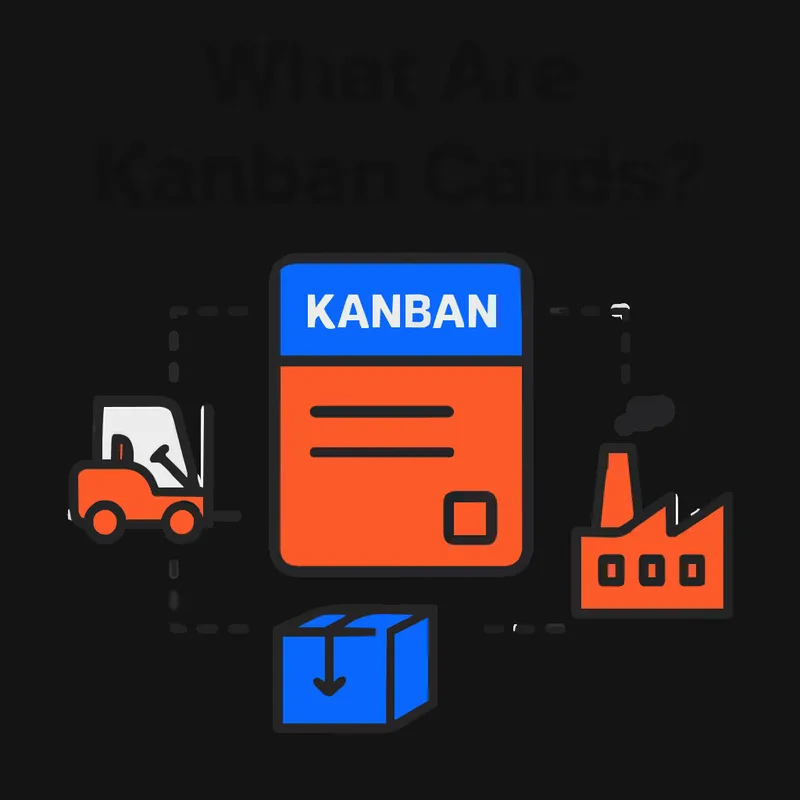
What Are Kanban Cards? A Complete Guide for Manufacturing
What are kanban cards? Learn the 4 types used in manufacturing, how they control inventory and production flow, plus procedures for stock pickers and material handlers.
A kanban card is a visual signal that tells the floor to replenish or produce a specific part. One card stands for one container of that part, and when the container empties, the card is the authorization to refill it.
In this guide, we'll cover everything you need to know about kanban cards in manufacturing: what they are, the different types, their core functions, and how they fit into real-world production workflows. If you are new to lean manufacturing, or tuning a kanban card system you already run, this guide gives you practical steps to apply on the floor.
What Are Kanban Cards?
Kanban cards are visual signals that control the flow of production and inventory in a manufacturing process. Each card represents a specific part, component, or product that needs to be produced, moved, or replenished. At their most fundamental level, kanban cards are visual representations of work items that move through different stages of production.
The term "kanban" comes from Japanese, meaning "signboard" or "billboard," reflecting the system's visual nature. Originally developed at Toyota in the late 1940s, kanban cards were physical cards attached to parts bins that signaled when more components were needed on the production line.
A kanban card is used to signal that materials need replenishment — and that signal is what drives the entire pull production system. Instead of producing based on forecasts, production is triggered by actual customer demand, flowing upstream through the supply chain via these simple but powerful cards.
Once you know what a card has to signal, the next step is printing them. You can make your first kanban cards free and have them on the bins this afternoon.
Types of Kanban Cards in Manufacturing
There are several types of kanban cards used in manufacturing environments, each serving a specific purpose in the production process:
Production Kanban Cards
A production kanban card authorizes an upstream process to produce a specific quantity of parts for a downstream process. When a production kanban card is received, it signals permission to manufacture more of a particular item. These are sometimes called "P-kanbans" and are the most common type on the shop floor.
Withdrawal or Transport Kanban Cards
Withdrawal kanban cards (also called transport or conveyance kanbans) authorize the movement of materials between stages or locations in the production process. They ensure materials are delivered to the correct place at the right time. In a two-bin system, the withdrawal kanban is what tells a material handler to pull a new container from the upstream supermarket.
Signal Kanban
Signal kanban is used for processes with long changeover times. This type of kanban triggers production when inventory reaches a predetermined minimum level, similar to how a kanban reorder point works. Signal kanban is ideal for batch production environments where you can't produce single pieces on demand.
Supplier Kanban
Supplier kanban cards extend the kanban system to external suppliers, signaling when to deliver more materials or components to the manufacturing facility. These cards create a direct communication channel between your shop floor and your vendors, eliminating the back-and-forth of traditional purchase orders for repeat items.
Understanding these different types allows manufacturers to implement the right mix of kanban cards for their specific production needs and constraints.
What Information Goes on a Kanban Card?
Every kanban card contains the essential information needed to take action without additional communication. A well-designed kanban card typically includes:
- Part number and description — exactly what item needs to be produced or moved
- Quantity — how many units per container or batch
- Source location — where to pick up or produce the item
- Destination location — where to deliver it
- Supplier information — for supplier kanbans, who provides the material
- Container type — the bin, rack, or container the parts travel in
- Lead time — how long replenishment takes from signal to delivery
Modern kanban cards often include QR codes that link to a digital backend, giving you real-time visibility into consumption data, reorder history, and inventory levels without cluttering the physical card. This hybrid approach — simple physical cards with smart digital tracking — is what makes tools like Arda especially effective for manufacturers who want easy-to-use inventory control without the complexity of a full ERP system.
The Core Functions of Kanban Cards in Manufacturing
Kanban cards fulfill several critical functions within a manufacturing environment:
Visual Workflow Management
Kanban cards serve as immediate visual indicators of production status on the manufacturing floor. These cards enable teams to instantly identify component status, responsible operators, bottlenecks, and priorities without additional communication.
In manufacturing, kanban cards physically travel with materials through production stages, creating a self-documenting workflow that eliminates status meetings and reports. The cards themselves communicate all necessary production information.
Color-coding can enhance functionality — red cards might indicate urgent assembly line needs, while yellow represents standard replenishment. This visual system allows floor managers to make immediate production decisions without consulting complex schedules.
When kanban cards accumulate at specific stations, bottlenecks become instantly visible, allowing managers to allocate resources proactively before delays affect downstream processes. This visual approach embodies lean manufacturing by promoting transparency and enabling real-time adjustments based on actual factory floor conditions.
Inventory Control and Optimization
One of the primary benefits of kanban cards is their ability to optimize inventory levels throughout the manufacturing process. By implementing a pull system, kanban ensures that:
- Production is driven by actual demand rather than forecasts
- Materials are only ordered when needed — no overstocking
- Overproduction is minimized — you only make what's been consumed
- Stock levels remain optimal — enough to prevent stockouts, lean enough to avoid waste
Organizations implementing kanban systems with kanban cards typically achieve a 20-30% reduction in inventory costs by eliminating excess stock and preventing overproduction.
In a traditional two-bin system, for example, when the first bin of parts is empty, the kanban card attached to it signals the need to replenish stock. While waiting for the new order, production continues using parts from the second bin. This creates a self-regulating inventory system that maintains just enough stock without excess.
Communication and Coordination Tool
Kanban cards serve as powerful communication tools that facilitate coordination between different departments, production stages, and even external suppliers. Each card carries exactly the information someone needs to act — no emails, no phone calls, no confusion.
This is especially valuable on busy shop floors where miscommunication about what to order, how much, and when leads to chronic stockouts and production delays. Kanban cards eliminate the "he said, she said" by making every replenishment decision visible and traceable.
How Kanban Cards Support Pull Production Systems
In traditional push systems, production is driven by forecasts, with materials and components being produced in anticipation of demand. This often leads to overproduction and excess inventory.
In contrast, pull systems only produce what is needed when it's needed, based on actual customer demand. Kanban cards facilitate this by creating a chain reaction of signals that move upstream through the production process:
- When a customer orders a product, it creates demand at the final production stage
- This stage "pulls" the necessary components from the preceding stage
- This pull action is communicated via a Kanban card
- The preceding stage then pulls what it needs from its upstream supplier
- This pattern continues all the way back to raw materials
This chain reaction, initiated by customer demand and flowing upstream via material withdrawal requests, is managed and communicated through Kanban cards.
How Kanban Cards Fit Into Manufacturing Workflows
Let's look at how Kanban cards typically flow through a manufacturing system:
- A downstream process consumes materials from a container
- When the container is emptied, the attached withdrawal Kanban card is removed
- This card is placed in a collection box for the material handler
- The material handler uses this card to retrieve a new container from the upstream supermarket (inventory buffer)
- When taking the new container, the production Kanban attached to it is removed
- This production Kanban is sent back to the producing process
- The producing process is now authorized to make one more container of parts
This cycle ensures that no parts are produced or moved unless a corresponding kanban signal is present, maintaining a strict pull system driven by actual consumption.
Try Arda's Free Kanban Card Creator: Your First Step to Inventory Control
Try the completely free Kanban generator from Arda that lets you create professional Kanban cards with QR codes, no strings attached.
What You Can Do With Our Free Tool:
- Generate custom Kanban cards for your most critical inventory items
- Create cards in bulk by uploading a simple CSV file (template provided)
- Print professional-quality cards ready for immediate shop floor use
- Experience the visual simplicity that makes Kanban so effective
Create your free Kanban cards now and take the first step toward inventory control.
Use Kanban Cards As Your Manufacturing Operations Secret Weapon
Despite their simple appearance Kanban cards can deliver a truly powerful impact on your manufacturing operation. These cards create transparency, establish production rhythm, and eliminate waste, turning chaotic environments into synchronized, demand-driven systems.
Their genius lies in simplicity. By clearly communicating production needs, Kanban cards create an intuitive system everyone understands. This transparency builds accountability and drives continuous improvement across all levels of operation.
From Toyota's factory floors to today's digital adaptations, Kanban cards continue proving their value by balancing structure with flexibility. They enable precise customer response while maintaining optimal inventory levels.
The question isn't whether your manufacturing operation can benefit from Kanban cards, but rather how quickly you'll begin to capture their advantages in efficiency, quality, and customer satisfaction. Give Kanban cards a try and see the impact they can have on your manufacturing operation.
Make the first replenishment loop visible.
Generate free Kanban cards for the parts that most often stop production.
Make Free Kanban CardsRelated reading
Benefits of Kanban in Manufacturing: A Complete Guide
Explore the proven benefits of kanban in manufacturing — from waste reduction and lower lead times to real-time inventory control. Includes examples, card types, and implementation tips.
Mar 20, 2026Read article
JIT vs Kanban: Which Is Better for Preventing Stockouts?
Struggling with stockouts? Compare just in time inventory vs. Kanban and discover why Kanban's visual pull system offers superior resilience.
Oct 31, 2025Read article
20 Kanban Statistics Every Manufacturer Needs to Know
Discover 20 powerful Kanban statistics that show how to slash lead times by up to 90%, cut inventory costs, and dramatically improve production efficiency.
Jun 13, 2025Read article