
Push vs Pull Inventory Management: What Should You Choose?
Push vs pull inventory management compared side-by-side. Learn how each system works, when to use them, and how a hybrid approach optimizes your supply chain.
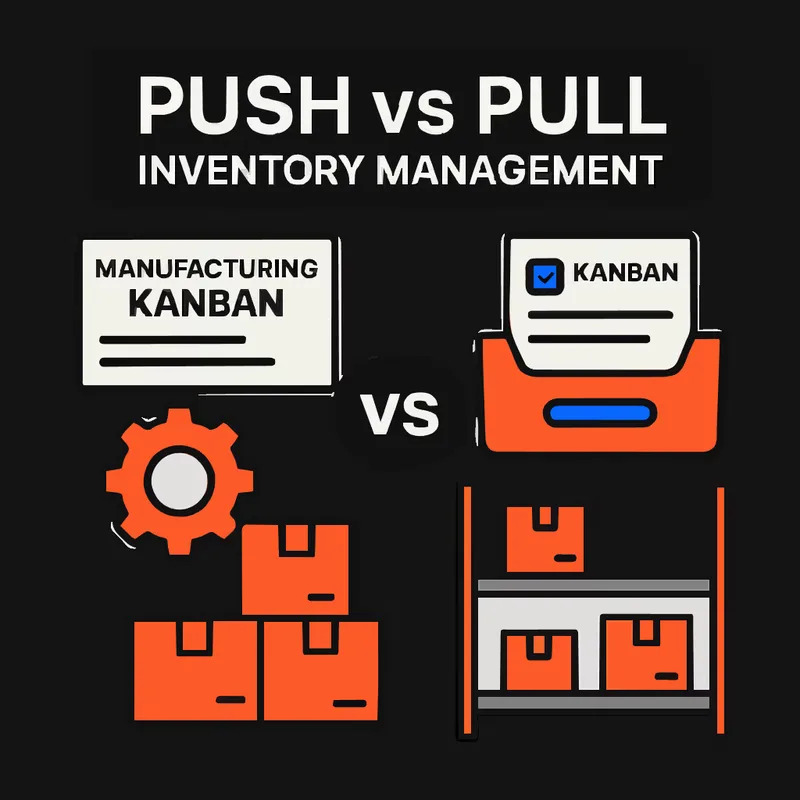
The way you manage inventory can make or break your manufacturing business. At the core of inventory control techniques lies a fundamental choice: should you implement a push system, a pull system, or a hybrid approach? This decision affects everything from your operational costs and efficiency to customer satisfaction and competitive advantage.
Push inventory management produces goods based on demand forecasts and pushes them through your supply chain before orders arrive. Pull inventory management waits for actual customer demand to trigger production and replenishment. Understanding the differences between these two approaches is crucial for optimizing your manufacturing processes and maximizing profitability.
Let's break down how each system works, compare their strengths and weaknesses side by side, and help you determine which strategy aligns best with your manufacturing goals.
Push vs Pull Inventory Management: Side-by-Side Comparison
Before diving into the details, here is a quick push vs pull inventory management comparison to frame the key differences:
Factor Push System Pull System Production trigger Demand forecasts Actual customer orders Inventory levels Higher — stock produced in advance Lower — stock produced as needed Lead time to customer Shorter — products already on shelf Longer — production starts at order Flexibility Lower — committed to forecast plans Higher — adapts to real demand Risk of overstock Higher — forecast errors create excess Lower — only produce what is ordered Risk of stockout Lower — buffer inventory available Higher — depends on replenishment speed Best for Stable, predictable demand Variable or customized demand Cost advantage Economies of scale from bulk production Lower carrying costs and less waste Also known as Make-to-stock (MTS) Make-to-order, just-in-time (JIT)This comparison shows the fundamental trade-off: push systems prioritize availability and cost efficiency through scale, while pull systems prioritize responsiveness and waste reduction through demand-driven replenishment.
How Push Systems Work for Inventory
Push inventory management, often called "make-to-stock," operates on the principle of anticipating future demand through forecasting. In this system, products are manufactured according to predicted needs rather than in response to specific customer orders.
In a push system, production planning begins with demand forecasting. Using historical data, market trends, and other predictive tools, manufacturers estimate future sales and create production schedules accordingly. Products are then manufactured and "pushed" through the supply chain to distribution centers and retailers, often in quantities larger than immediate demand requires.
Think of a bakery that prepares dozens of bagels each morning based on their prediction of how many customers will want them that day. The bagels are made before any specific customer has requested them because the bakery anticipates a certain level of demand.
The push approach is particularly common for products with stable, predictable demand patterns. Industries like food production, pharmaceuticals, and household essentials frequently employ push systems because consumer needs for these items tend to follow recognizable patterns.
Advantages of Push Inventory Management
1. Buffer Against Demand Spikes
When unexpected surges in customer demand occur, push inventory management provides a crucial safety net for your manufacturing operation. With products already manufactured and strategically positioned throughout your distribution network, you can respond to these demand spikes without the delays that might otherwise disappoint customers and damage your reputation.
This buffer is particularly valuable for manufacturers dealing with seasonal products or promotional periods when demand patterns can shift dramatically with little warning. Consider the experience of toy manufacturers who implement push inventory management to navigate the holiday shopping season. By producing steadily throughout the year, they ensure adequate stock availability during the critical fourth-quarter selling period.
The buffer created by push inventory management also provides protection against supply chain disruptions that might otherwise impact your ability to serve customers. When raw material shortages, transportation delays, or supplier issues arise, your existing inventory allows you to continue fulfilling orders while you resolve these upstream challenges.
2. Economies of Scale
One of the most compelling advantages of push inventory management is the cost efficiency gained through larger production runs. By manufacturing in substantial batches based on forecasted demand, you can significantly reduce your per-unit production costs, a benefit that flows directly to your bottom line.
These savings materialize through several mechanisms:
- Setup cost dilution: The fixed costs associated with equipment setup and calibration are spread across more units, reducing the per-unit impact
- Volume discounts: Larger raw material orders typically qualify for preferential pricing from suppliers
- Equipment efficiency: Continuous production runs minimize the productivity losses associated with frequent changeovers
- Labor optimization: Workers achieve higher efficiency through task repetition and reduced downtime between production runs
For manufacturers of standardized products with stable demand patterns, these economies of scale can create a significant competitive advantage in price-sensitive markets.
3. Long Lead Time Accommodation
When your manufacturing operation depends on components or raw materials with extended procurement timelines, push inventory management provides the necessary buffer to maintain consistent operations despite these supply chain realities.
This advantage becomes particularly critical when:
- Your raw materials come from international suppliers, with shipping times extending to weeks or even months
- Your components require specialized manufacturing processes with limited global capacity
- You rely on seasonal raw materials that are only available during specific harvest periods
- Your suppliers face capacity constraints that limit their ability to respond quickly to orders
This stability translates directly to more reliable customer delivery performance and fewer emergency expediting costs.
4. Stability in Seasonal Businesses
For manufacturers facing predictable seasonal fluctuations, push inventory management enables production smoothing throughout the year, a strategy that creates numerous operational advantages beyond simple inventory availability.
By distributing production more evenly across your annual calendar, you can:
- Maintain workforce stability: Avoid the costly cycle of layoffs during slow periods and rushed hiring/training during peak seasons
- Develop stronger supplier relationships: Replace feast-or-famine ordering patterns with more consistent purchasing volumes that make you a preferred customer
- Optimize equipment utilization: Achieve higher return on capital investments by maintaining more consistent equipment usage rates throughout the year
- Implement more effective maintenance programs: Schedule preventive maintenance during natural production lulls rather than forcing downtime during peak periods
- Reduce overtime expenses: Minimize premium labor costs by avoiding the production crunch that typically precedes seasonal demand spikes
Food processors provide an excellent example of this advantage in action. Rather than attempting to process all seasonal harvests simultaneously, they implement push inventory management to extend production runs and warehouse finished goods, reducing their peak labor requirements.
5. Simplified Production Planning
The longer production runs characteristic of push inventory management create a more predictable and manageable manufacturing environment. This simplification yields benefits that extend throughout your operation:
- Reduced scheduling complexity: With fewer changeovers and longer runs of standardized products, production planners can create more stable schedules that remain valid for extended periods
- More consistent workflows: Production teams benefit from the rhythm and predictability of manufacturing the same products for longer durations
- Predictable maintenance scheduling: Equipment maintenance can be planned with greater confidence when production schedules remain stable
- Routine quality control: Quality assurance processes become more routine and efficient when product specifications remain consistent across longer production runs
- Simplified material handling: Warehouse operations benefit from receiving larger quantities of fewer SKUs, reducing picking errors and improving storage efficiency
Challenges of Push Inventory Management
1. Overproduction Risk
Perhaps the most significant challenge of push inventory management is the inherent risk of producing more than the market demands. Since production decisions are based on forecasts rather than actual orders, discrepancies between projected and actual demand can leave you with excess inventory that consumes valuable resources without generating revenue.
This risk is magnified by several factors that affect forecast accuracy:
- Market volatility: Unexpected economic shifts, competitive actions, or consumer behavior changes can render even the most sophisticated forecasts obsolete
- New market entrants: Competitors introducing alternative products can quickly erode your market share and demand projections
- Changing consumer preferences: Shifts in buyer preferences or emerging trends can reduce demand for previously popular products
- Forecast bias: Often trending toward optimism in sales projections
According to industry data, forecast accuracy typically ranges from 60-80% even in stable markets, meaning some level of mismatch between production and actual demand is almost inevitable.
2. Higher Carrying Costs
The elevated inventory levels inherent in push inventory management create significant carrying costs that directly impact your profitability. These expenses extend far beyond the simple opportunity cost of capital tied up in inventory.
Multiple sources indicate that the average inventory carrying cost for manufacturers typically falls within a range of 15% to 35% of the total inventory value annually. These costs encompass:
- Capital costs: The opportunity cost of funds invested in inventory rather than other business initiatives
- Storage expenses: Warehouse space, utilities, and facility maintenance
- Handling costs: Labor for receiving, storing, counting, and managing inventory
- Insurance premiums: Coverage protecting inventory against damage, theft, or loss
- Inventory taxes: Property taxes assessed on inventory holdings in some jurisdictions
- Obsolescence risk: The statistical probability that inventory will become unsellable before it's consumed
For manufacturers with slim profit margins, these carrying costs can significantly erode profitability. Understanding how inventory costs compound is essential for making an informed push vs pull inventory management decision.
3. Obsolescence Concerns
For products with short lifecycles or those subject to rapid innovation, push inventory management significantly increases the risk of inventory becoming obsolete before it sells, a particularly costly form of waste in manufacturing operations.
Even in well-run companies, anywhere from 20% to 30% of inventory is dead or obsolete. This obsolescence challenge manifests in several ways:
- Technological obsolescence: Newer versions or technologies render existing inventory outdated and less desirable
- Market obsolescence: Changes in consumer preferences or trends reduce demand for previously popular products
- Competitive obsolescence: Rival products with superior features or lower prices diminish the value of your inventory
- Regulatory obsolescence: New standards or regulations may make existing products non-compliant
- Physical obsolescence: Deterioration of products or raw materials during extended storage periods
The financial impact extends beyond the simple write-off value of the obsolete inventory. You'll also face:
- Markdown requirements to move aging inventory
- Disposal costs for truly obsolete items
- Warehouse space inefficiently occupied by non-performing stock
- Management attention diverted to obsolescence mitigation rather than growth initiatives
4. Limited Flexibility
Once production plans are established and executed in a push inventory management system, your ability to quickly adapt to changing market conditions becomes significantly constrained. This rigidity creates several operational challenges:
- Slow response to emerging customer preferences: When consumer tastes shift, your existing inventory may no longer align with market demand, while your production pipeline continues creating products based on outdated forecasts
- Difficulty accommodating rush orders or special requests: With production capacity already committed to forecast-based manufacturing, accommodating unexpected customer opportunities often requires disrupting established production schedules
- Challenges in resource reallocation: Capital, labor, and equipment committed to producing forecasted items cannot be easily redirected to emerging opportunities
- Resistance to product improvements: Engineering changes or product enhancements may be delayed to avoid obsoleting existing inventory, potentially putting you at a competitive disadvantage
This reduced agility can be particularly problematic in fast-moving industries where product lifecycles are shortening and customer expectations for customization are increasing.
5. Environmental Impact
The potential for overproduction inherent in push inventory management creates sustainability concerns that extend beyond simple financial considerations. When forecasts exceed actual demand, the resulting excess inventory often becomes waste, representing squandered resources and unnecessary environmental impact.
Several environmental consequences of overproduction include:
- Raw material consumption: Resources extracted and processed to create products that may never be used
- Energy usage: Manufacturing processes consume energy regardless of whether the resulting products fulfill actual market needs
- Carbon footprint: Production, transportation, and storage of excess inventory generate greenhouse gas emissions
- Waste generation: Unsold or obsolete products eventually require disposal, often in landfills
The Guardian reports that in the fashion industry alone, as many as 40% of clothes made each year (60 billion garments) are not sold, requiring radical changes in production to tackle this waste. While manufacturing sectors vary in their overproduction rates, push inventory management inherently increases this sustainability risk compared to demand-driven alternatives.
Forward-thinking manufacturers are increasingly incorporating environmental considerations into their inventory strategy decisions, recognizing that sustainability performance is becoming as important as financial metrics for many stakeholders.
Types of Push Systems and Where They Excel
Push inventory management works best when your manufacturing operation deals with specific business conditions:
-
Stable, predictable demand patterns: Products with consistent, foreseeable demand cycles benefit most from push approaches. Examples include basic consumer staples (paper products, cleaning supplies), standard industrial components with predictable replacement cycles, and products with long, established sales histories and minimal variation.
-
Long production lead times: When manufacturing processes require significant time from start to finish, push systems help ensure product availability. This applies to complex manufactured goods requiring multiple production stages, products requiring aging or curing processes, and items with specialized testing or certification requirements.
-
High setup costs: Products where changing production runs is expensive or time-consuming benefit from the longer runs typical in push systems. Items requiring specialized tooling or molds, products manufactured on equipment with lengthy calibration processes, and goods requiring extensive cleaning protocols between production runs all fit this category.
-
Limited production windows: Some products can only be manufactured during specific periods due to raw material availability or other constraints, including seasonal agricultural products, items with weather-dependent production processes, and products tied to specific annual events or holidays.
Industries like consumer packaged goods, basic apparel, and standard building materials often benefit from push approaches due to their relatively stable demand patterns and the efficiency of large production runs.
Related reading

What Are Kanban Cards? A Complete Guide for Manufacturing
What are kanban cards? Learn the 4 types used in manufacturing, how they control inventory and production flow, plus procedures for stock pickers and material handlers.
Mar 20, 2026Read article
Kanban Pull System: How It Works + Implementation Guide
Learn how kanban pull systems drive demand-based inventory replenishment. Covers the 4 core principles, signal types, implementation steps, and real results.
Mar 20, 2026Read article
The Disadvantages of Just-in-Time for Manufacturers
Discover the disadvantages of just-in-time systems and how Kanban systems create more resilient supply chains for sustainable growth.
Oct 31, 2025Read articleMake the first replenishment loop visible.
Generate free Kanban cards for the parts that most often stop production.
Make Free Kanban Cards